Call for Papers
The call for papers is closed. Submissions closed on July 13, 2026, and the workshop takes place on October 9, 2026 in Naples, Italy — see the program. The call is kept below for reference.
Generative AI is changing how people interact with health technology. Large language models, multimodal foundation models, and conversational agents make it possible to combine text, speech, vision, and physiological signals in ways that weren’t practical a few years ago, and they raise difficult questions about usability, safety, explainability, trust, and evaluation when the stakes involve someone’s health.
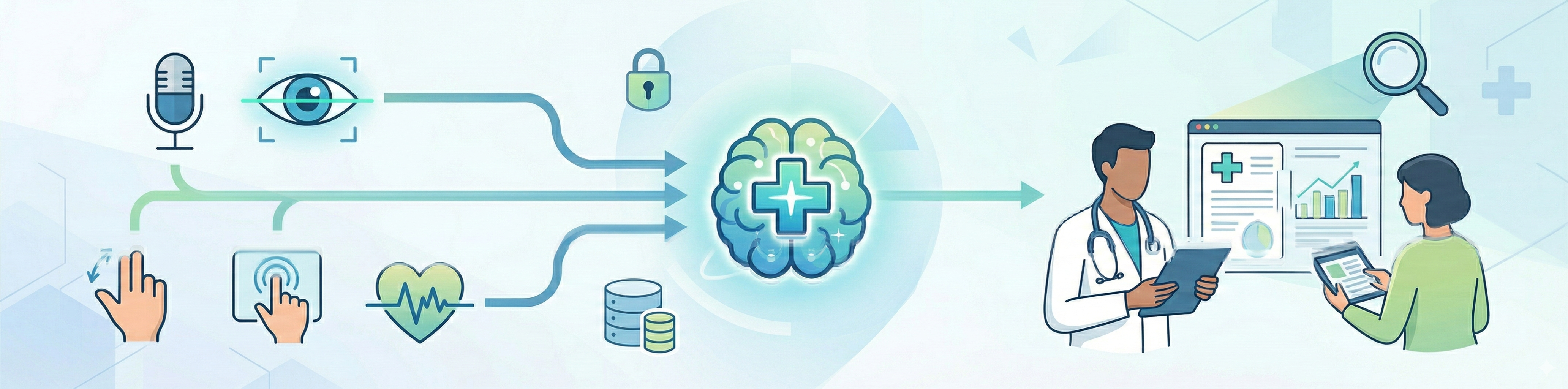
HeMAI 2026 brings HCI, AI, and health researchers together to work through those questions. We welcome contributions on multimodal interaction techniques for health systems, conversational and embodied agents in healthcare, integration of text/speech/vision/biosignals, explainability and transparency, human-AI collaboration, safety and trust, ethical and regulatory issues, evaluation methodologies, and real-world deployments.
Topics of Interest
Topics include (but are not limited to):
- Multimodal interaction techniques for AI health systems
- Conversational agents and embodied AI in healthcare
- Integration of text, speech, vision, and biosignals
- Explainability and transparency in generative health AI
- Human-AI collaboration in clinical and self-care settings
- Safety, reliability, and trust in AI-driven health applications
- Ethical, privacy, and regulatory challenges
- Evaluation methodologies for multimodal generative systems
- Real-world deployments and case studies
Submission Types
We welcome:
- Full research papers (up to 8 pages, excluding references)
- Short / work-in-progress / position / demo papers (up to 4 pages, excluding references)
Submissions followed the ICMI 2026 author guidelines. Papers rejected from the main ICMI track were welcome if they fit the scope.
Workshop papers will be indexed by ACM Digital Library in an adjunct proceedings to ICMI 2026.
Submission via PCS is closed.
Important Dates
See Important Dates.
Workshop Goals
The workshop aims to:
- Foster interdisciplinary exchange between HCI, AI, and health researchers
- Identify research challenges and future directions
- Encourage responsible innovation in multimodal generative health AI
We look forward to seeing you in Naples.